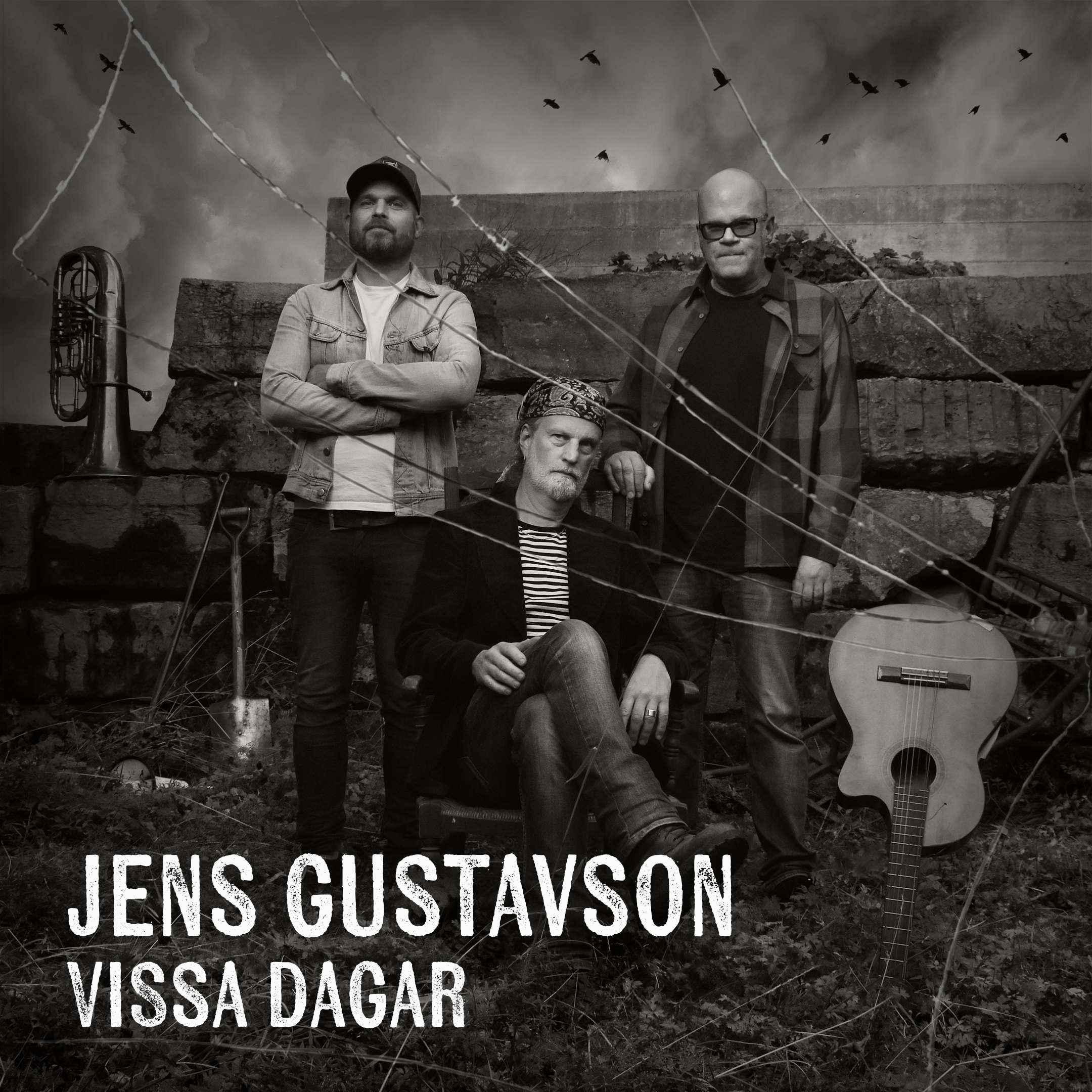
*Vissa dagar* announces itself through absence rather than presence. The rootsy, stripped-down approach that defines this collection represents not merely a stylistic shift but a kind of musical excavation, revealing the bones beneath the flesh. Recorded largely live at Studio Rissna City in Jämtland, the album carries the stark beauty of the Swedish inland—those desolate highways that feature in "Kommer hem" become both literal and metaphorical terrain.
The opening track, "Humlor," sets the tone with its meditation on humanity's self-destructive pursuit of wealth and dominance. Here, as throughout, Gustavson's approach favours directness over ornament. The production work by Robin Lindqvist understands that intimacy demands space; the arrangements breathe, allowing Göran Backlund's double bass and Ronny Dahlberg's percussion to establish a foundation that never overwhelms the songwriting itself.
"Vissa dagar"—the title track—operates as the album's emotional pivot. Critics have noted its raw honesty and chorus designed for collective voice, and indeed, the song functions as both personal testimony and communal ritual. This duality runs throughout the record: Gustavson writes from specific experience yet manages to locate the universal within the particular.
The musical palette draws from New Orleans blues, European folk traditions, and acoustic indie without ever feeling derivative. "Kanske just det här" exemplifies this synthesis—a travelogue that doubles as philosophical inquiry, its naked arrangement allowing every word and note its proper weight. When Ulf Wahlström's slide guitar appears, it does so as punctuation rather than decoration, a single brushstroke that completes the picture.
Gustavson's background in the alternative scene manifests not through volume but through sensibility. The tension and sensitivity that defined his live performances with the raucous Andras Ungar find new expression here in restraint and negative space. "Huset," described elsewhere as offering an "unsettling soundscape," achieves its power through what remains unspoken—a fractured relationship examined with the cool gaze of someone who has survived it.
The album's scope extends beyond personal narrative. "Chant" confronts the erosion of tolerance in contemporary discourse, while "Vals för utmattade" captures the existential weight of ordinary mornings. These are songs that understand political engagement need not announce itself through rhetoric; sometimes the most radical act is simply bearing witness.
Comparisons to Ossler and Anders F. Rönnblom locate Gustavson within Sweden's progressive folk tradition, yet the spectral presence of PJ Harvey and Mark Lanegan suggests a darker, more experimental sensibility. The album navigates this territory with confidence, never quite settling into any single genre long enough to become predictable.
The choir contributions from Ulrika Persdotter Dahlberg and Gustaf Ullbrandt provide texture without prettiness, while Fredrik Ståhl's Helicon adds an almost liturgical quality to certain passages. Gustavson himself handles guitars, banjitar, harmonica, piano, and percussion—a one-man orchestra who understands that versatility serves the song, not the ego.
*Vissa dagar* rewards patience. These are not songs that reveal themselves immediately; they unfold gradually, like landscapes emerging through morning fog. The autobiographical snapshots of "Numera" accumulate weight through understatement, while "Kommer hem" transforms a simple road trip into something approaching the transcendent.
For an unsigned, independently released work, the album demonstrates remarkable cohesion. Gustavson has clearly learned that freedom from commercial pressure allows for artistic risk—the kind that produces work of genuine substance. After nearly thirty years of making music on his own terms, he has created something that justifies that long commitment: an album that speaks quietly but insistently, and lingers long after the final notes fade.