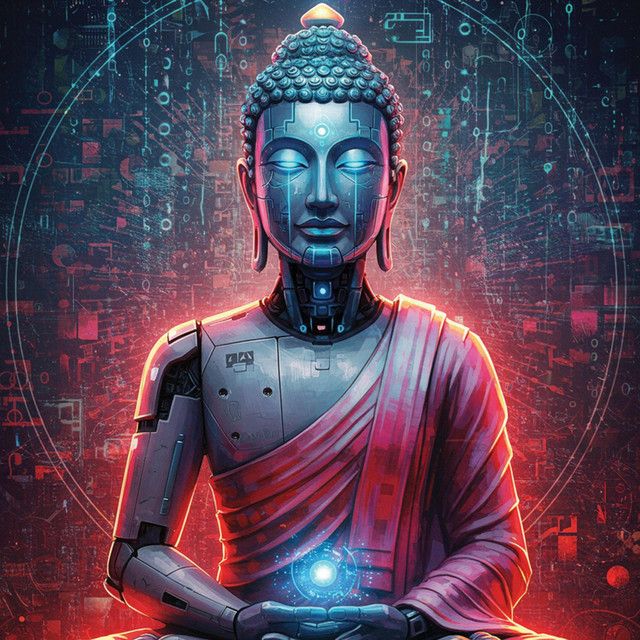
The conceptual framework is bold: using artificial intelligence as a creative partner to explore Buddhist philosophy through EDM and techno. The "MK 2" designation suggests refinement, iteration—a fitting metaphor for the Buddhist concept of continuous practice and improvement. One imagines the algorithm as a kind of digital meditation partner, processing and reprocessing until something approaching enlightenment emerges from the speakers.
What's immediately striking about *AI Buddha MK 2* is how Haeder has managed to avoid the pitfalls that typically plague "spiritual" electronic music. There's no New Age vapidity here, no pan-flute serenity or crystal-bowl platitudes. Instead, Haeder embraces the full sonic palette of modern dance music—driving beats, processed textures, the occasional controlled chaos of techno—while maintaining an underlying sense of contemplative purpose. It's music for the rave as spiritual practice, the dancefloor as temple.
The AI-driven production techniques Haeder employs create soundscapes that feel both ancient and futuristic. There's something appropriately paradoxical about using cutting-edge technology to explore teachings that are millennia old, and this tension animates the album's most successful moments. The machine learning algorithms seem to have absorbed something of Buddhism's essential non-attachment, creating sounds that arise, evolve, and dissolve with an almost organic fluidity.
Structurally, the album unfolds with a logic that recalls the progressive stages of meditation. Early tracks pulse with restless energy—the "monkey mind" of Buddhist teaching made manifest in skittering hi-hats and relentless bass. As the album progresses, spaces open up. Silence becomes as important as sound. The production gradually strips away layers rather than adding them, a sonic representation of the path toward simplicity and clarity.
Yet this isn't music that preaches or pedagogically explains. Haeder wisely avoids the didactic, trusting instead in pure sonic experience to convey whatever insights the Dharma might offer. There are no spoken lectures on the Four Noble Truths, no chanted sutras buried in the mix. The Buddhism here is structural, atmospheric, implicit—felt rather than explained.
The decision to create this work entirely within his own studio, using AI as collaborative tool, raises fascinating questions about authorship and creativity that Buddhism itself has long grappled with. If there is no permanent self, who exactly is the author of these tracks? Is the AI a modern koan—a puzzle designed to short-circuit rational thought and point toward deeper understanding?
*AI Buddha MK 2* is admirably uncompromising in its vision. This is music that demands attention, that refuses to function merely as background ambience. It's challenging, occasionally abrasive, and utterly committed to its peculiar fusion of ancient wisdom and contemporary technology. Whether Haeder has achieved genuine sonic enlightenment is perhaps beside the point—the journey itself, with all its risks and revelations, is what matters.
In an electronic music landscape increasingly dominated by algorithmic playlists and AI-generated content, Haeder has found a way to make the machine serve genuinely human—and humanistic—purposes. *AI Buddha MK 2* stands as proof that technology and spirituality need not be opposing forces, and that the quest for meaning can thrive even in the most unlikely sonic spaces. It's a groundbreaking work that deserves serious attention from anyone interested in where electronic music might be headed.