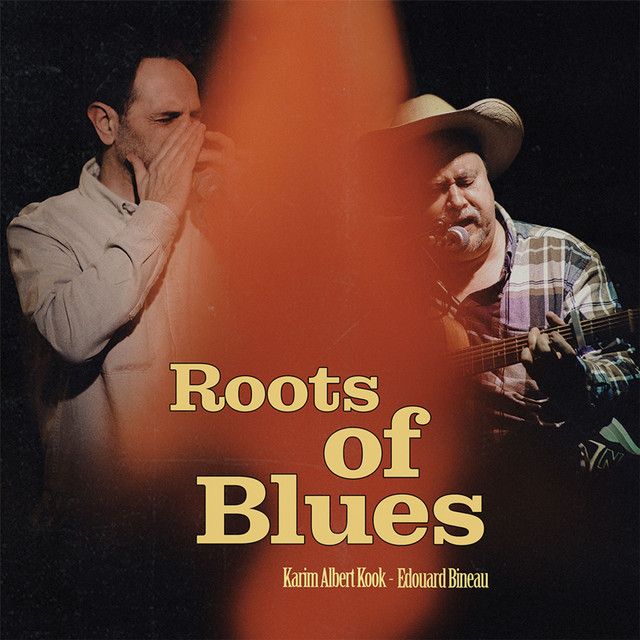
Kook's journey to the blues began with profound adversity—a childhood illness that confined him to a wheelchair, leading his family from Algiers to Toulouse in search of treatment. It was a guitar, a gift from his brother, that became his salvation and escape route from the monotony of hospital corridors. This biographical detail illuminates every note he plays: the blues found him as much as he found it, a genuine autodidact who discovered in Muddy Waters, Sonny Boy Williamson, and Robert Johnson not just musical heroes but kindred spirits in the art of transforming suffering into song.
His voice carries the weight of this personal history—weathered not by affectation but by genuine experience. The guitar work, entirely self-taught, draws its power from instinct rather than conservatory training, creating unexpected parallels between North African modal inflections and the pentatonic landscapes of the Mississippi Delta. This is not fusion for fusion's sake, but rather a recognition that the blues was always a global conversation, conducted in the vernacular of human suffering and resilience.
The trajectory from Toulouse hospital rooms to the stages of New Morning and Palais des Congrès, sharing bills with B.B. King, reads like blues mythology made manifest. His previous albums—"Les choses ressemblent à ça" (featuring Luther Allison), "Je roule vers toi," and "Barbès City Limit Blues"—document a gradual evolution from promising newcomer to mature artist. The recent "Il était un voyage" suggested a musician ready to expand his palette, incorporating brass and keyboards while maintaining his essential blues identity.
Édouard Bineau's harmonica provides the perfect counterpoint, his "souffle vibrant" breathing life into spaces that lesser players might merely fill with technical showmanship. The interplay between the two musicians suggests years of shared musical dialogue, each phrase building upon the last with the confidence of old friends finishing each other's sentences. For Kook, this partnership represents both a return to roots and a natural evolution—the blues as conversation rather than monologue.
Across twelve tracks, the duo reimagines blues standards through the lens of their respective backgrounds, French and Algerian roots intertwining like the very migration patterns that shaped America's musical DNA. Their approach eschews the reverent museum-piece treatment that often suffocates blues revival projects. Instead, they inhabit these songs with the urgency of musicians who understand that tradition is not a relic to be preserved but a living organism to be nourished.
The album's evocation of "bars clandestins et des rues poussiéreuses du Sud profond" is more than atmospheric window dressing—it represents a genuine attempt to capture the clandestine spirit that has always animated the blues. These are songs that sound as comfortable in a Marseille backstreet as they would in a Chicago speakeasy, a reminder that the blues has always been about outsiders finding their voice.
Roots of Blues succeeds as both musical statement and cultural document. Kook and Bineau have created not merely another blues album, but a meditation on what it means to be displaced, to carry one's history in the curve of a bent note and the rasp of a weathered voice.
The blues, as they present it, is not American music played by Europeans, but human music played by humans—a distinction that makes all the difference.