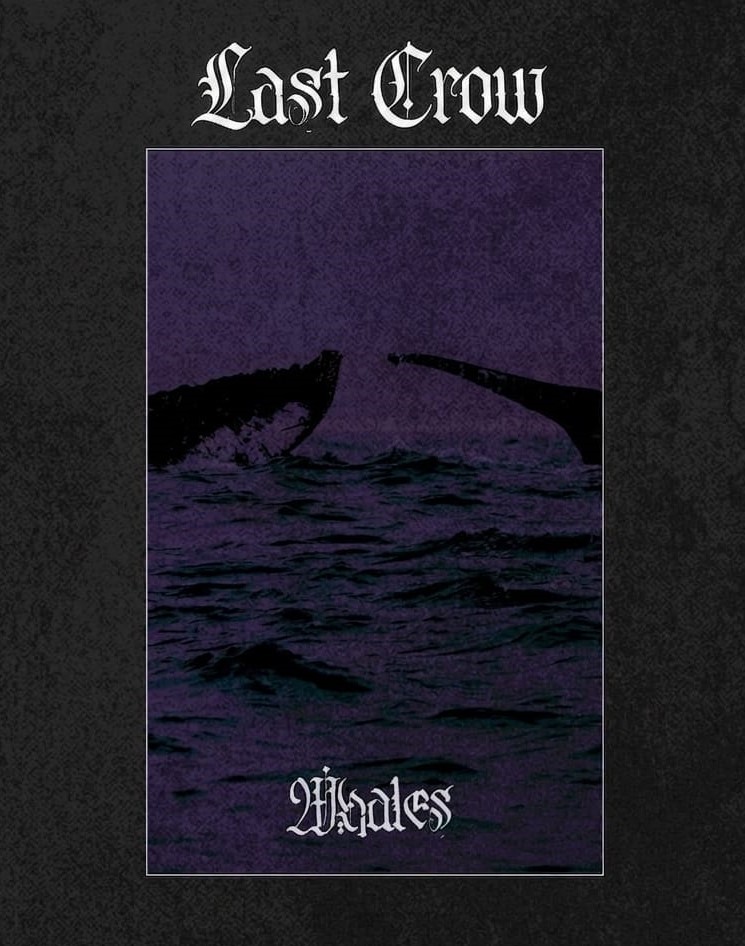
The backstory alone is the stuff of minor legend: three Spaniards, a Finn, and an Englishman converge in a town in Andalusia, a region more associated with flamenco dust and whitewashed walls than the cosmic drift of psychedelic doom. Yet geography, as Last Crow demonstrate with quiet insistence, is no limitation. The band's international pedigree feeds directly into the music — you can hear The Doors' late-night dissolution, the California desert heat of Kyuss, and the darker, more European heaviness of Monolor all folded into the arrangement, not as pastiche but as digested vocabulary. These are musicians who have absorbed their influences so thoroughly that the seams have become invisible.
The production history matters here. "Whales" was recorded in a home studio, at the guitarist's own house, on limited equipment — and the fact that this is audible is its greatest virtue. The recording carries the warmth and faint imperfection of a space that has been lived in, not sanitised. The guitars do not gleam; they glow. The keyboards have a slight humidity to them, as if the notes are sweating in the afternoon heat. When the heavy passages arrive, they do not crash so much as they settle, like something enormous finding its depth.
Central to the track's identity is the interplay between those guitar tones and the vocal melody — a combination that the band themselves describe as their defining discovery, and it is not hard to hear why. The vocals sit above the heaviness with a surprising lyricism, melodic lines that curve and resolve in ways that suggest classical training or, more likely, an innate sense of counterpoint. This is not singing-over-riffing; it is two separate conversations being held simultaneously, each making the other more interesting by contrast. The keyboard work, meanwhile, provides the connective tissue: harmonic colour, harmonic surprise, a solo passage that arrives precisely when the track threatens to settle into comfort.
Heavy music is rarely this patient; rarely this willing to let a silence breathe before splitting it open. Last Crow understand that dread and beauty are not opposites in the psychedelic tradition — they are collaborators. Fans who have followed the band's development apparently agree that with "Whales" they have found their sound, their identifying mark. It is the kind of remark that sounds like hyperbole until you hear the track and recognise it as simple observation.
Lyrically, the band have spoken of a desire to create an escape route from the current world, and the track functions accordingly — not as an act of denial but of immersion. Whether they can sustain this level of coherence across a full album remains to be seen. But "Whales" does not feel like an accident. It feels like the first clear transmission from a group that has been trying to say something specific, and has finally found the frequency.