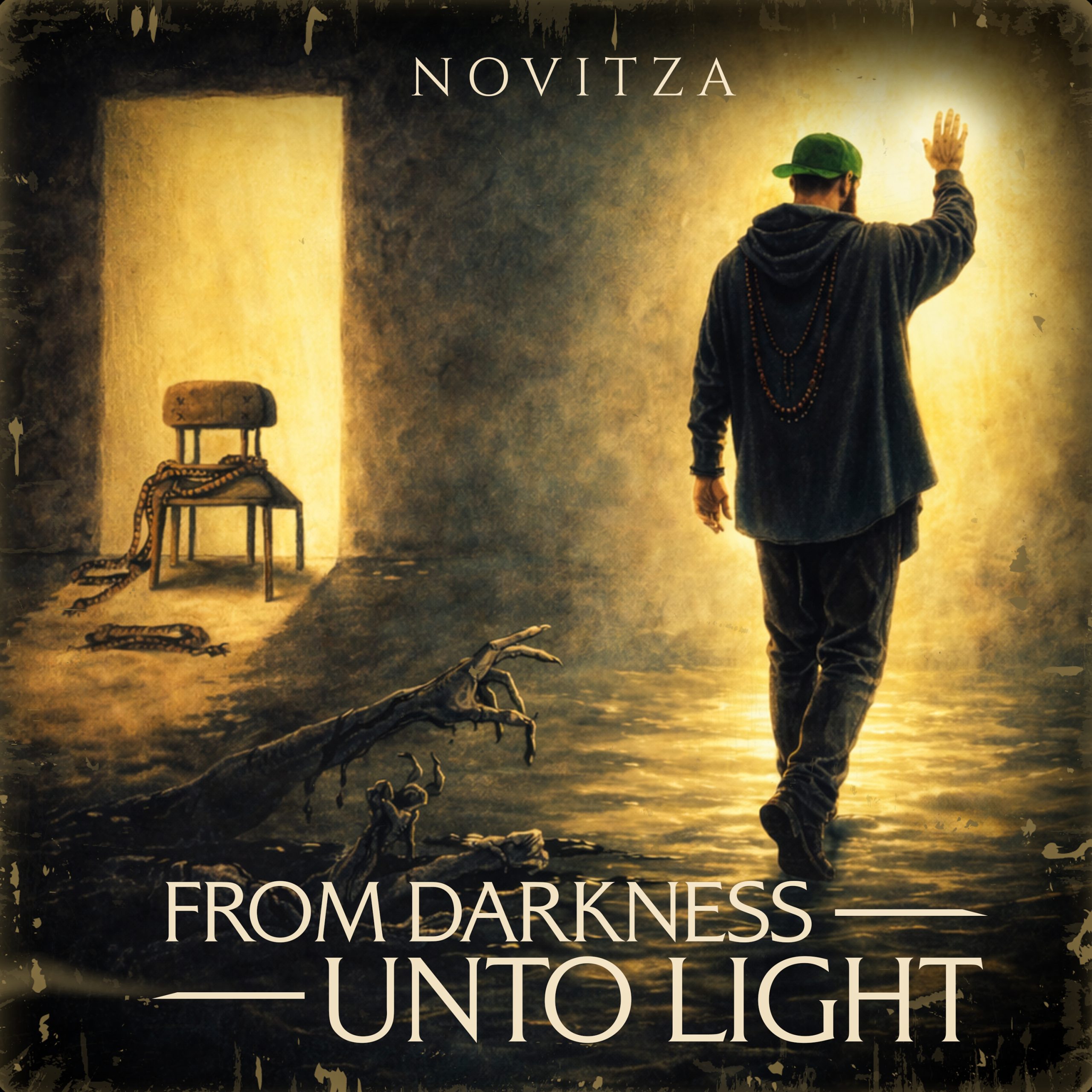
Novitza is Montenegrin, classically trained in voice and guitar, and the record was made in London — a city to which he has a relationship both complicated and, evidently, necessary. He attempted an opera audition there more than a decade ago, without success. That the music now bearing his name was recorded in the same city feels less like coincidence than quiet reckoning: a settling of accounts conducted not with bitterness but with the particular dignity of someone who has taken the long road and arrived, at last, on their own terms.
The music itself occupies that increasingly populated but rarely navigated territory between post-minimalist classical composition and contemporary cinematic orchestration. The comparisons one reaches for almost immediately — Max Richter's patient layering, Arvo Pärt's tintinnabular purity — are ones that Novitza himself acknowledges, and it is to his credit that these influences feel absorbed rather than imitated. His music does not sound like a conservatoire exercise in the aesthetics of restraint. It sounds like a person.
What distinguishes the EP from the broader field of ambient-adjacent orchestral releases — a genre which, let us be honest, is prone to a certain interchangeable tasteful melancholy — is the presence of a genuine compositional intelligence at work. The orchestrations breathe without becoming slack; the emotional temperature is carefully modulated without ever feeling managed or manipulative. Novitza is clearly a composer who distrusts cheap catharsis, and the record is all the more affecting for it. When the music does open up, the effect is one of earned release rather than manufactured climax.
His background in classical singing gives the vocal work a formal grounding that prevents it from dissolving into mere atmosphere. The voice is used instrumentally at times, as texture and colour rather than vehicle for lyric meaning, but when words do surface, they carry the specific gravity of someone who has thought carefully about what language can and cannot do that music cannot do alone.
The Balkan folk elements, to their credit, are worn lightly. They surface not as ornament or marketing hook — the record does not announce itself as "world music" in the patronising sense — but as a natural seam running through the material, a reminder that this composer comes from somewhere specific and has brought that specificity with him. It gives *From Darkness Unto Light* a grounded quality that purely cosmopolitan productions sometimes lack: the music knows where it is from, even as it aspires to a wider address.
There is, inevitably, a question about where one places a record like this in the culture. It sits outside the conventional pop infrastructure without being classical in any institutional sense; it is too emotionally direct for the more cerebral end of the contemporary composition world, too formally rigorous for easy radio consumption. This is not, in fact, a problem — it is a description. The best music tends to resist easy categorisation, not through wilful eccentricity but because its maker has followed the work wherever it needed to go, regardless of market adjacency.
*From Darkness Unto Light* is a debut of genuine seriousness. It is quiet, charged, and difficult to dismiss. Novitza has returned to London not to prove something to the city that once turned him away, but to offer something to it. That is a more interesting proposition than revenge, and a more lasting one.