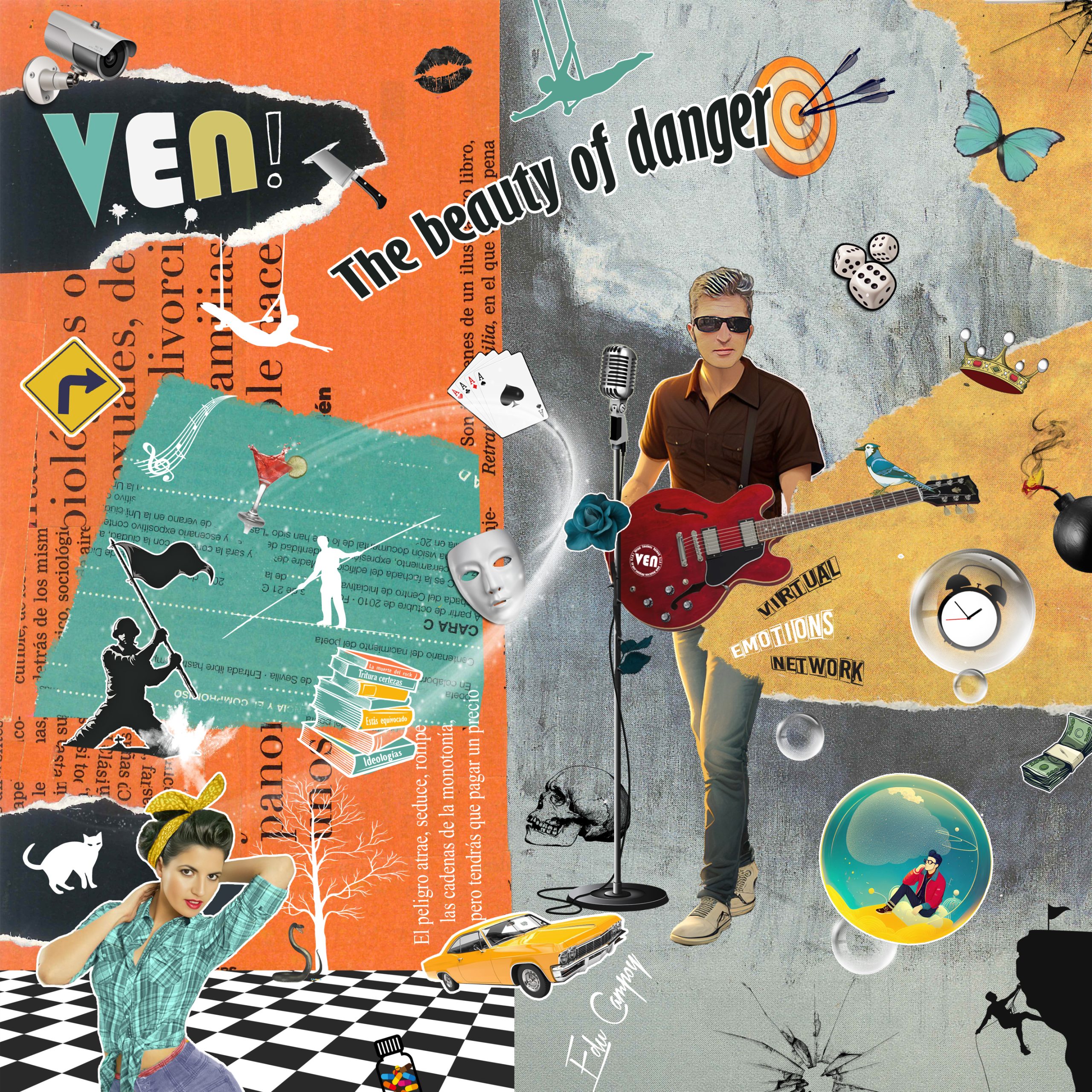
*THE BEAUTY OF DANGER* is a work of controlled chiaroscuro. Campoy, who is also a visual artist of real accomplishment — producing intricate pop-art collages for each track, vivid and restless things that owe as much to Warhol's serial pleasures as to Peter Blake's cluttered romanticism — constructs five songs that make a compelling, almost defiant case for the idea that guitar music still has emotional frontiers left to explore. The visual and sonic vocabularies here are inseparable: bright, saturated, formally rigorous, and quietly radical beneath an accessible surface. His stated influences — Sixties pop, Britpop, post-punk, alternative rock — are worn not as costume but as skeleton. V.E.N! does not sound like anyone being quoted. It sounds like itself, which is the rarer achievement by far.
The opener, "CLOUD OF BLISS," establishes the terms of engagement with disarming swiftness. Twangy, hypnotic guitar work circles the listener like a kite riding a thermal before the vocals descend — warm, affecting, neither timid nor histrionic. "You live inside a pop song, it's like laughing at life," Campoy declares, and the line lands with the easy assurance of a man who has been sitting with this sentiment long enough to make it feel inevitable. Yet the song turns inward at its close — "If I feel sick, I think the world is also sick. But... is it really?" — and that unresolved question proves to be the EP's governing impulse. Self-awareness, spiritual searching, social scrutiny: all three are present from the first minute, and all three refuse to leave.
"NOW" is the EP's centrepiece and its most finely calibrated piece of writing. A bittersweet reflection on freedom and reinvention, it combines bright, almost giddy rhythms and arpeggiated guitars with a narrative of rare poignancy: a man who lived a hundred lives, rebelled without recognition, and died carrying the kind of freedom most people only ever theorise about. "Now is forever," Campoy repeats, and the refrain accumulates weight with each return, transforming from declaration into elegy. The backing organs swell at precisely the right moments; the harmonies arrive like light through the aforementioned cracks in the wall. One thinks of Jarvis Cocker at his most cinematically self-aware — not copying him, but occupying the same spiritual latitude.
Track three, "THE SILENCE OF GOD," is the record's most nakedly ambitious moment and, remarkably, entirely equal to its own ambitions. The lyric moves from exhaustion and spiritual desolation — "every day I'm more lost, more tired, more wrong, more trapped, but more awake" — toward a vision of astral liberation that is neither facile nor embarrassing, a combination of qualities almost impossible to achieve when the subject is the divine. Campoy wants to cross ghost towns at dawn, to know the secret the stars hide, to return with a message of hope. That the song makes you believe he just might is a considerable testament to his sincerity and craft. The production here has a genuine progressive rock muscularity to it — longer, more patient, more willing to let the arrangement breathe — and the final incantation, "I want to be the rain that feeds the earth, the ray that lights up the sky," lands with the force of something genuinely felt rather than merely written.
And then, with the gleeful tonal swerve that only a confident artist could execute without capsizing the whole enterprise, comes "COLIVING, POLYAMORY & e-SCOOTER." The title alone deserves some kind of prize. This is Campoy at his most sardonically sociological, a Kinksy survey of contemporary precarity — frozen wages, paper-walled rentals, eternal waiting lists, the gasoline-is-gold economy navigated by a man on an electric scooter who tells himself, with decreasing conviction, "I am in control." The chorus — "We are all middle class" — lands somewhere between anthem and epitaph. The song's genius is that it is simultaneously funny and genuinely bleak, a piece of pop-art social commentary that Ray Davies would recognise and respect. It confronts the realities of modern life with the same sharpness that marks the best of the Britpop tradition, without ever mistaking cleverness for feeling.
Closer "WALK ON FIRE" completes the arc with considerable grace. Against a backdrop of boys fighting in the mud and television spreading fear, Campoy constructs an intimate sanctuary — two people, a piano, a melody, a gaze that allows one to rise and fly. It is a love song, but also a philosophical position: the personal as the last defensible territory when the public realm has become uninhabitable. The guitar-synth interplay shimmers with a Pulp-esque quality, though the emotional register is warmer and less ironic than Cocker typically permits himself.
Taken whole, THE BEAUTY OF DANGER moves from intimacy to spirituality to social satire to private love — and does so with the coherence of a record that knows exactly what it is. It runs to five tracks and leaves you wanting considerably more, which is either a flaw of ambition or a masterstroke of editorial control. Given the evidence of this record, the latter seems overwhelmingly more likely.
Verdict: Melodically fearless, lyrically alive, socially awake, and over far too soon. Listen immediately. Then start again from the beginning.