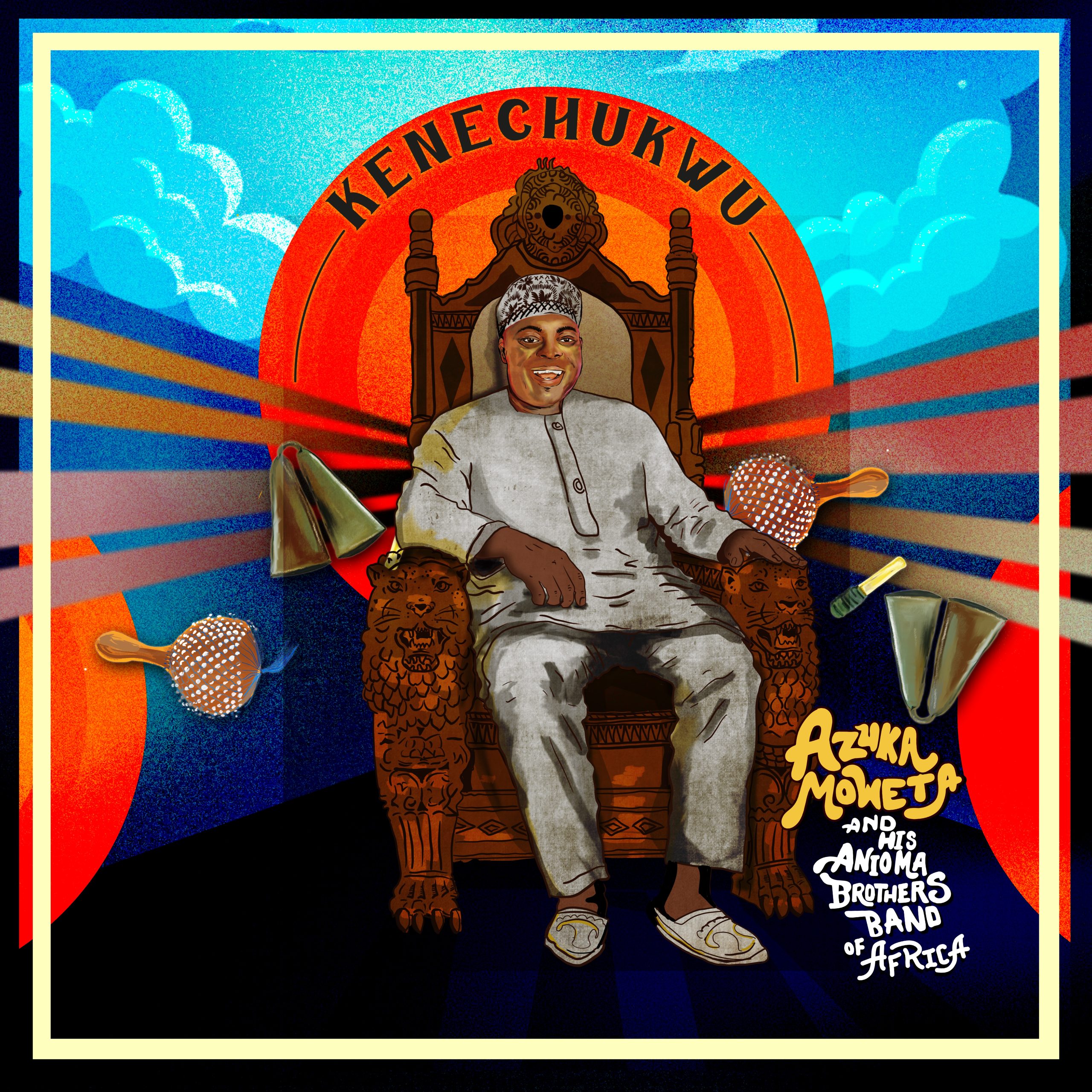
The album's title is itself a statement of intent. *Kenechukwu* — "give thanks to God" in Igbo — frames the entire record as an act of devotion before a single note is heard. And Moweta earns that framing. His style sits at the precise crossroads of Ekobe music and Igbo Highlife, filtered through an Asaba accent that lends the whole enterprise a distinctiveness one simply hasn't encountered before. Ekobe is a tradition built from the belly of a culture rather than imported from anywhere — drawing on Igbo instruments including the clay pot *udu*, the long gong *ogene*, maracas *ichaka*, wood block *okpokoro* and native drum *igba*, accompanied by vocal chants, representing a people, their struggles, and their very way of life. To hear it fused with highlife's gently swaying electric guitars and brass arrangements is to hear something ancient and modern negotiating, gracefully, as old friends.
The album opens with *Uwa Bu Onye Zusia*, a tribute to the trumpeter Zeal Onyia, and the choice could not be more fitting nor more canny. Onyia was one of the founders of West African highlife in both Ghana and Nigeria, playing Ellington-style swing and dance with Bobby Benson in the 1940s and classic highlife with ET Mensah in the 1950s, before going on to provide stiff competition for Fela Kuti's first band as a small jazz combo leader in the early 1960s. Louis Armstrong himself, upon first hearing Onyia, called him "the highlife hep cat of Nigerian jazz trumpet." Moweta does not attempt to impersonate this giant; he does something considerably wiser. He passes the flame. The track does not wallow in nostalgia — it pulses with the conviction that tradition is a living thing, worth carrying and worth celebrating. The horns are not weeping; they are dancing.
The title track arrives next and earns its position fully. The Ekobe pulse locks against an electric guitar figure that you cannot shake, and Moweta's voice rises into something approaching a hymn of thanksgiving — celebratory without ever tipping into complacency. The Creator "giveth life," the song insists, and the groove insists right alongside it that you had better move your feet in acknowledgement. *Ndi Di Mma* follows, a warm rolling tribute to those everyday figures of kindness who keep communities intact and functioning — the unsung saints, the good-hearted neighbours. It is the sort of song that makes you feel, briefly but genuinely, that humanity might be fundamentally decent after all.
*Izu Nwanne Ka* tightens the thematic circle further: brotherhood, it declares with infectious certainty, is the ultimate form of wealth. *Odogwu Ahaba* crowns the Delta warrior spirit — proud, forthright, unapologetic — and the band sounds magnificent doing it, the rhythm section locked and determined, the horns bold. Then comes the album's most revealing moment: *Ogalanya Sound System*, a fully instrumental track that strips away all vocal scaffolding and lets the Anioma Brothers Band speak entirely through musicianship. Horns ride high; the percussion breathes and chatters in that distinctly Ekobe manner; the groove proves itself to be royalty without needing the king's robe. It is the album's most confident statement, and all the more effective for its restraint.
The closing *Nyem Nkem* seals the record's ethical compact: share what you have, love those beside you, praise while you have breath to do so. It is not naïve — Moweta has lived too much to peddle naivety — but it is sincere, and sincerity performed this well is a form of courage.
Ekobe music is as old as the Igbo race itself, but has remained largely untapped by recording artists willing to project it globally. Moweta has taken it upon himself to champion the form, fusing it with highlife, and the journey has been an adventure. Released through the Colombia-based Palenque Records — a label with a remarkable instinct for identifying where African and diasporic musics converge into something both rooted and universal — *Kenechukwu* finds Moweta at his most assured and most generous.
This is a record that asks nothing of the listener except attention and an open pair of ears. Give it those two things, and it gives back considerably more.