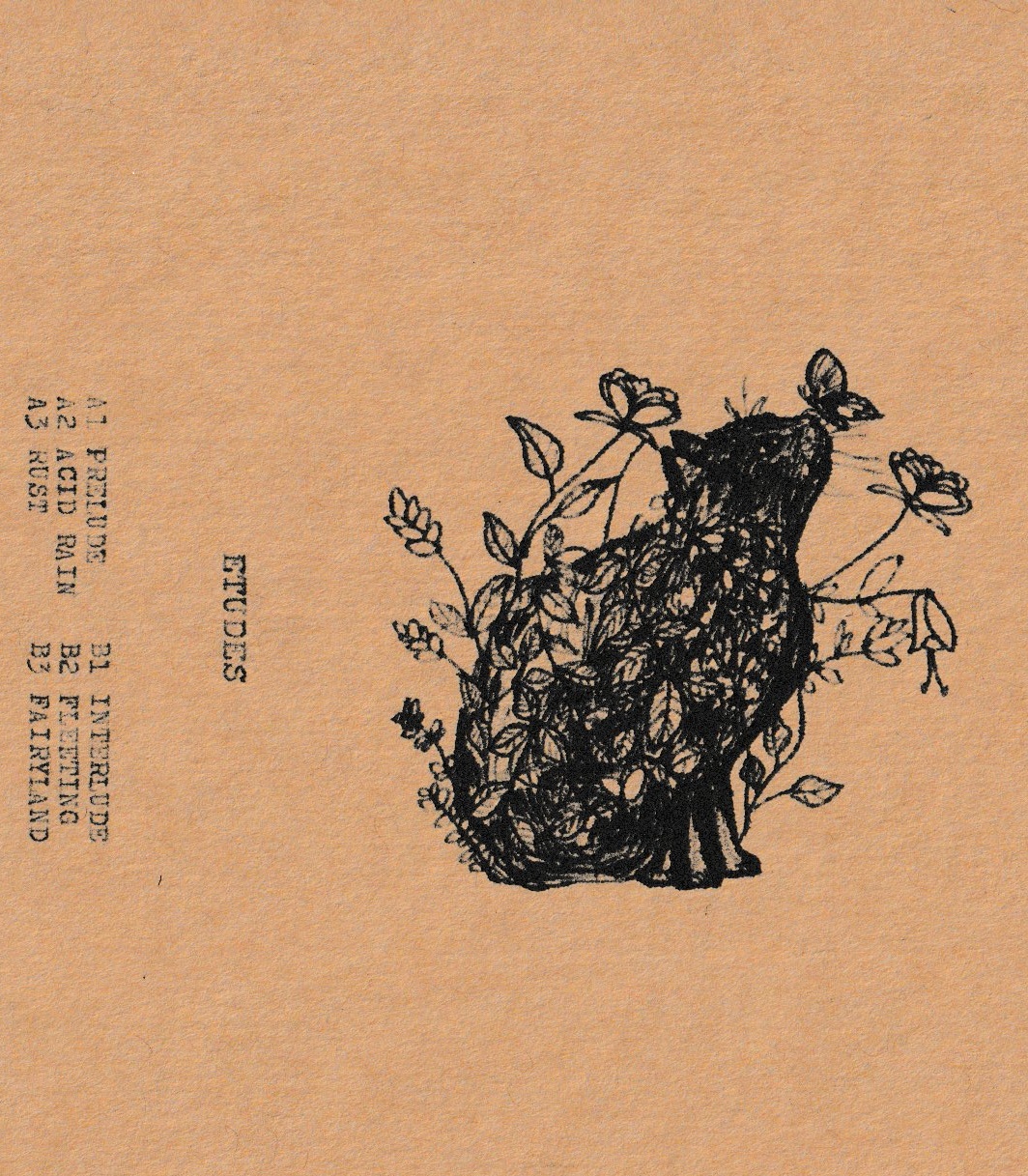
This is music born from isolation and patience. Returning to his family home after the pandemic's upheavals, Matsumoto embarked on the painstaking work of restoration—not merely of his found instruments, but of something more elusive: a private language between player and object, between intention and accident. That he handled every aspect of the production himself, from the initial tuning of broken strings to the final mastering and cassette artwork, speaks to an artistic vision both hermetic and uncompromising.
The EP opens with "Acid Rain" and "Fairyland," which Matsumoto describes as the yin and yang of the collection, and the designation proves apt. "Acid Rain" feels appropriately corrosive, its experimental textures suggesting both the deterioration of found materials and their radical transformation. The piano's timbre carries the weight of its years, imperfections preserved rather than polished away. Against this, the double bass provides a gravitational anchor, its resonance speaking to the physical labour of restoration—each note earned through careful calibration of an instrument never meant to sing again.
"Fairyland" offers counterbalance without resorting to mere prettiness. Here, Matsumoto's classical training emerges more clearly, intricate melodic phrases unfolding with mathematical precision even as they maintain an improvisational spontaneity. The production, recorded in winter 2024-2025 using modest equipment—Circuit Rhythm, Zoom H4n, Rode M5—reveals itself as deliberately spare. This is not poverty of imagination but aesthetic choice: Matsumoto understands that intimacy requires proximity, and overproduction would only distance listener from source.
Throughout *Études*, one senses a composer grappling with the fundamental question of what remains when traditional structures are dismantled. His approach to the étude form—historically a study piece designed to develop technique—becomes something far more conceptual. These are not exercises in virtuosity for its own sake, but meditations on limitation, on what broken things can still articulate. The double bass, never quite restored to conventional functionality, becomes an instrument of beautiful failure, its compromised voice lending authenticity that pristine equipment could never achieve.
The EP's introspective quality never tips into solipsism. Matsumoto's arrangements, however intricate, maintain a generous clarity of purpose. His multi-instrumentalist approach creates conversation rather than monologue, each voice distinct yet interdependent. The experimental flourishes—processed textures, unexpected timbral shifts—serve structural ends rather than mere decoration. This is music that rewards close listening while never demanding it as prerequisite for engagement.
Matsumoto's decision to document this material on cassette feels both nostalgic and pointed. The format's inherent warmth and fragility mirror the instruments themselves, objects saved from obsolescence through sheer determination. That the cover design also came from his hand completes the circuit: *Études* exists as total artwork, every element bearing his fingerprints.
The EP raises inevitable questions about sustainability. Can this level of hermetic control extend beyond a debut? Will future work require collaboration, or will Matsumoto continue mining this productive solitude? For now, such concerns feel premature. *Études* succeeds magnificently on its own terms: a fully realized statement from an artist who has earned the right to speak softly, confident that we will lean closer to hear. The four-year journey he documented has yielded music that justifies every moment of patience, every hour spent coaxing music from abandoned wood and wire.
Matsumoto has announced himself as a significant voice in experimental composition, one who understands that innovation often requires not the newest technology but the oldest instruments, approached with fresh ears and willing hands.