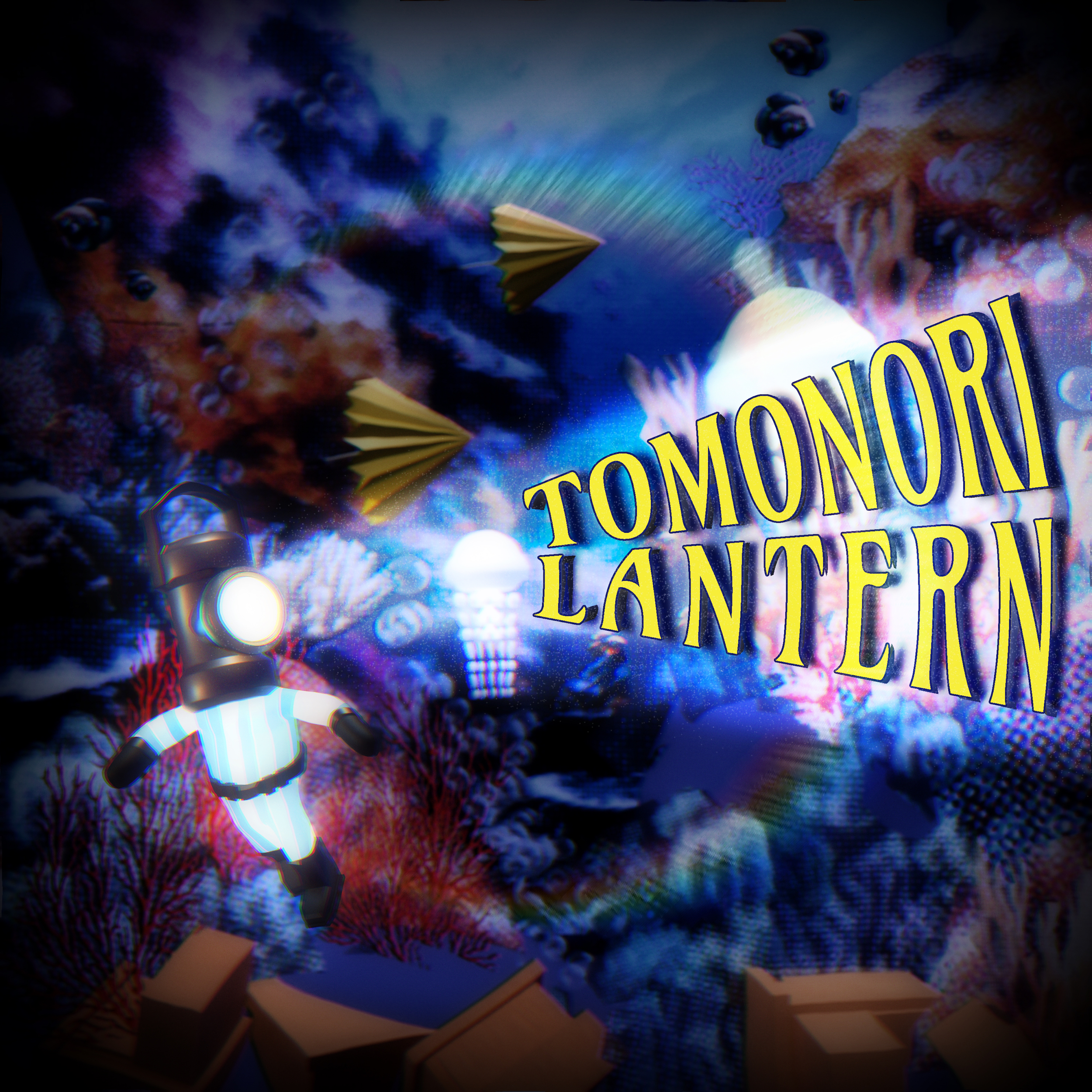
The production is immediately arresting. Afropop's rhythmic buoyancy collides with indie pop's introspective tendencies and electronic music's textural possibilities, creating a soundscape that feels perpetually in motion yet curiously suspended. It's music that breathes—quite literally, if we're to take the lyrics at their word—through the skin rather than merely entering through the ears. Austin Leeds' mix captures this quality beautifully, allowing each element space to exist without ever feeling sparse or underpopulated.
Lyrically, Tomonori operates in a realm of sensory dislocation and underwater consciousness that recalls the more abstract moments of Radiohead's discography, though without that band's architectural grandeur. Instead, "Lantern" opts for something more intimate and internal. The opening image—"Sand touches my toes subliminally"—establishes a dreamlike register that the song never abandons. We're immediately unmoored, experiencing sensation at a remove, as if consciousness itself has become a kind of permeable membrane through which experience filters rather than crashes.
The recurring motif of submersion, of dancing with "deep-sea creatures," positions the narrator in a space between states: not quite drowning, not quite swimming, but existing in some third condition where "hypervigilance" paradoxically coexists with play and innocence. This is trauma's landscape, reimagined not as a site of paralysis but as an environment requiring new forms of navigation. The "dead, dead flakes" snowing from above suggest both sediment and memory, those fragments of past experience that perpetually drift downward into the depths where we store what we cannot yet process.
But "Lantern" resists becoming oppressively heavy. The chorus's declaration—"Light as a lantern / With all spontaneity"—offers a counterbalance, suggesting that even in these submerged states, we might find our own luminescence. The lantern becomes a self-generated light source, something carried into darkness rather than imposed from without. It's a quietly radical proposition: that we might illuminate our own way through psychological depths without requiring rescue or extraction.
Tomonori's vocals navigate these waters with appropriate ambiguity, neither fully embodied nor completely ethereal. There's a quality of detachment that serves the material well, a sense that the singer is both experiencing and observing these sensations simultaneously. This doubled consciousness—being submerged while also watching oneself be submerged—captures something essential about contemporary experience, about living with an awareness of one's own psychological processes even as one undergoes them.
The production choices support this thematic ambition admirably. The "pink noise flickering so fast it's slo-mo" isn't just a lyrical conceit but an auditory experience the track actually delivers. Rhythmic elements arrive in unexpected configurations, creating that sense of temporal distortion where speed and slowness become difficult to distinguish. YDTHXGRT's fingerprints are evident in the track's sophisticated layering, where pop accessibility never quite overwhelms the more experimental undercurrents.
As the lead single from the forthcoming *Hypernonchalant*, "Lantern" suggests an artist uninterested in easy answers or conventional wisdom about healing and processing. Instead, Tomonori offers something more ambivalent and perhaps more honest: an acknowledgment that sometimes the best we can manage is to carry our own light into dark places, dancing with whatever we find there, making peace with submersion rather than fighting constantly toward the surface. It's pop music as philosophical inquiry, and it marks Tomonori as a voice worth following into whatever depths come next.
Artwork by: cerulean stoicism MMXXV